 I now play Guitar Hero on the Expert Level. Over the course of the past 2 years, I've been able to watch myself learning this skill -- the first new physical skill I've learned in a while. For those who haven't seen Guitar Hero before (mom), the screen shows colored dots coming closer to the screen and finally passing over a line. You play the game by holding down a button corresponding to the colored dot (fret) and pressing a bar on the controller (strumming) at the same time. At the first level of the game, there are three colors of dots, and the tempo is relatively slow. The second level of difficulty expands out to four colored dots with faster tempos and more unusual rythyms, and the third and fourth levels add a fifth colored dot (fret) with even faster tempos and more complicated rythyms.
If I were to map out the different stages of skill acquisition for Guitar Hero and similar games (like Rock Band), I would say it's gone somewhat like this:
-
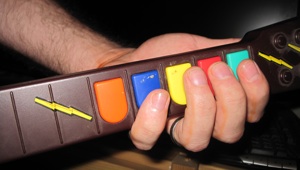 basic skill - the basic skill has two operating components with a third timing component:
- hold down the matching colored fret button for the dot that's coming on the screen
- press the strum bar at the same time
In this basic operating scenario, I mentally "mapped" my first, second and third fingers to each of the first three frets on the guitar, so my pointer finger is for the green button, my middle finger for the red button and my ring finger for the yellow button.
-
fourth fret (blue key) - this one was similar to the first three, but with the pinky added in.
-
fifth fret (orange key) - this introduces a bigger challenge. there are now five keys, but you've only got four fingers (your thumb is on the other side, holding the guitar up). At first you can kind of stretch your pinky over to hit the extra key
-
sliding - At some point, there are a lot of blue notes (fourth fret) and orange notes (fifth fret) and your pinky just can't go back and forth fast enough, so you slide your hand down so your ring finger is on the fourth fret and your pinky is on the fifth fret. this works great for those two keys, bun all your other fingers are on the wrong keys now. Your pointer finger is now on the second fret. It's no longer the "green" finger any more, now it's the "red" finger. At this point you have to completely re-map the way you have been playing the game. Learning to fully "slide" is one of the big challenges that many casual players never overcome.
-
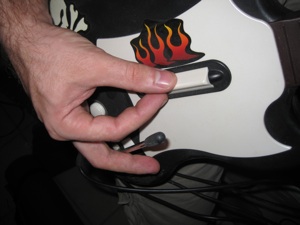 alternate strumming - At the beginning of the game when the notes are relatively far apart, you can just strum in one direction all the time. At some point, the tempos get too fast and you have to strum both up and down to play fast enough. I tend to use alternate strumming when there's a long run of the same note repeated very fast, or two different notes going back and forth.
-
switching between down and alternating strumming - Sometimes you have to switch back and forth between alternate strumming and regular strumming, and it takes skill to be able to make that change within a single beat.
At some point I was playing a song and I had a moment where my body ran faster than my mind. That is, my fingers were doing something that I was not consciously thinking of. "Whoah, how did I do that?" I realized then that it was in my muscle memory at that point. Muscle memory is how your body learns repeated physical motions so that they can be executed subconsciously. The signal goes in my brain and straight through to my muscles, without my even thinking about it. I have, at times, tried to invoke this muscle memory explicitly -- that is, tried to prevent my brain from consciously thinking about what I'm doing -- I haven't quite figured that one out yet.