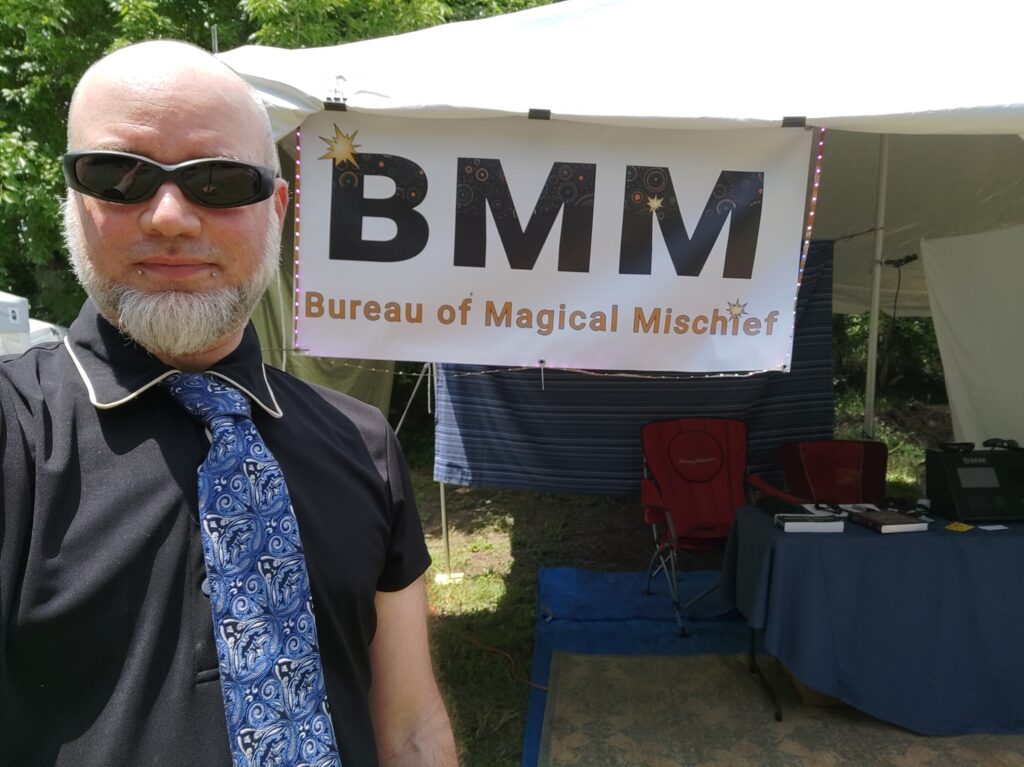
Recruiting Special Agents for the instigation of magical mischief
Bureau of Magical Mischief is a custom psychomagical art installation: a hand-built hardware kiosk that dispatched participating “agents” on personalized psychological missions during Burning Flipside 2023 near San Gabriel, Texas. Participants applied in advance, received a welcome letter and RFID card in the mail, then arrived at the event to find the station waiting for them: tap in, choose your mission, collect a printed ticket, and go. One hundred forty-eight agents enrolled. The hardware ran without failure.
THE IDEA
Burning Flipside is a regional Burning Man event, a temporary city where a different set of social rules applies for a long weekend. Art is everywhere, participation is the norm, and the usual structures that govern daily life are, for a few days, suspended. That context creates a genuinely permissive space for self-expression. The problem is that permission, on its own, doesn’t always translate into action. Where Flipside opens the door, BMM hands you a mission and says: walk through it.
The central design challenge was scalable personalization. Anyone can design a generic experience like a scavenger hunt, a prompt card, a directive to “go meet someone new.” And if we had hundreds of hours to spend in conversation with each individual participant before the event, we could have created a custom mission for each person. The interesting problem is the middle: how do you create something that feels tailored to a specific person without making the overhead of that tailoring prohibitive at event scale?
The solution came from collaborator Doug Harrison: use the Enneagram as a middleware layer between participant applications and mission assignment. The Enneagram is a personality typing system that organizes people into nine types, each with characteristic patterns of strength, growth, and challenge. Participants answered a brief online application; Doug reviewed each one and assigned an Enneagram type; missions were then drawn from a library of type-specific prompts matched to each agent’s particular edges and opportunities. The result was “a good compromise between a completely generic experience and one which required a lot of customization and overhead for each participant.“
The missions themselves were built around three principles: vulnerability, meaningful choices, and something at stake. Each one had a specific, clear completion moment – a line you crossed. They ranged from quietly introspective to loud and absurdist, but all of them asked agents to do something they might not have chosen on their own, and gave them the structure and cover to do it.
THE MISSION
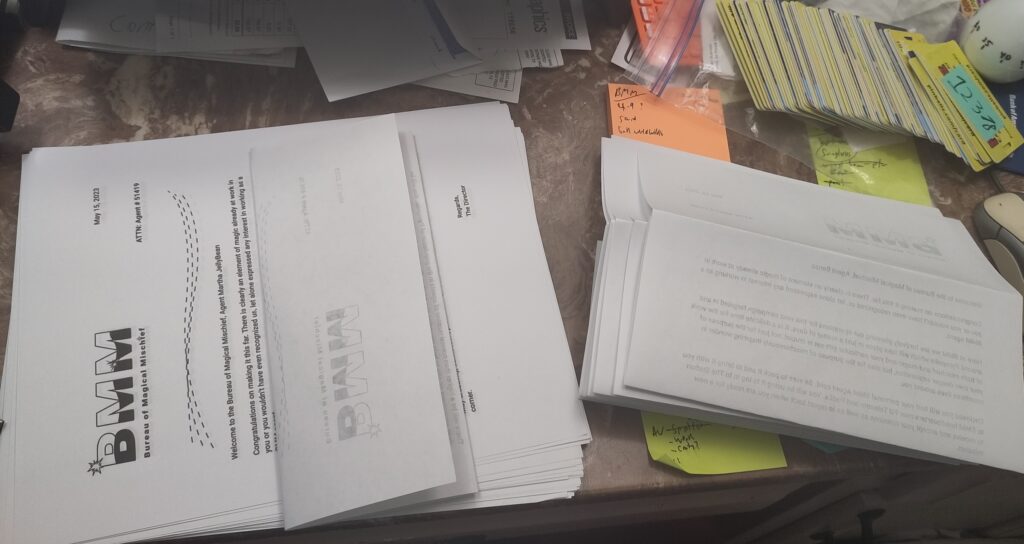
The agent experience began weeks before the event. Participants who enrolled online received, in the mail, a personalized welcome letter written in character as official correspondence from “The Director,” with their agent name, and instructions for what to expect. Enclosed in the envelope: a physical RFID card. The letter is not a confirmation email. It arrives in your house. It is an object. That distinction turned out to matter more than anticipated.
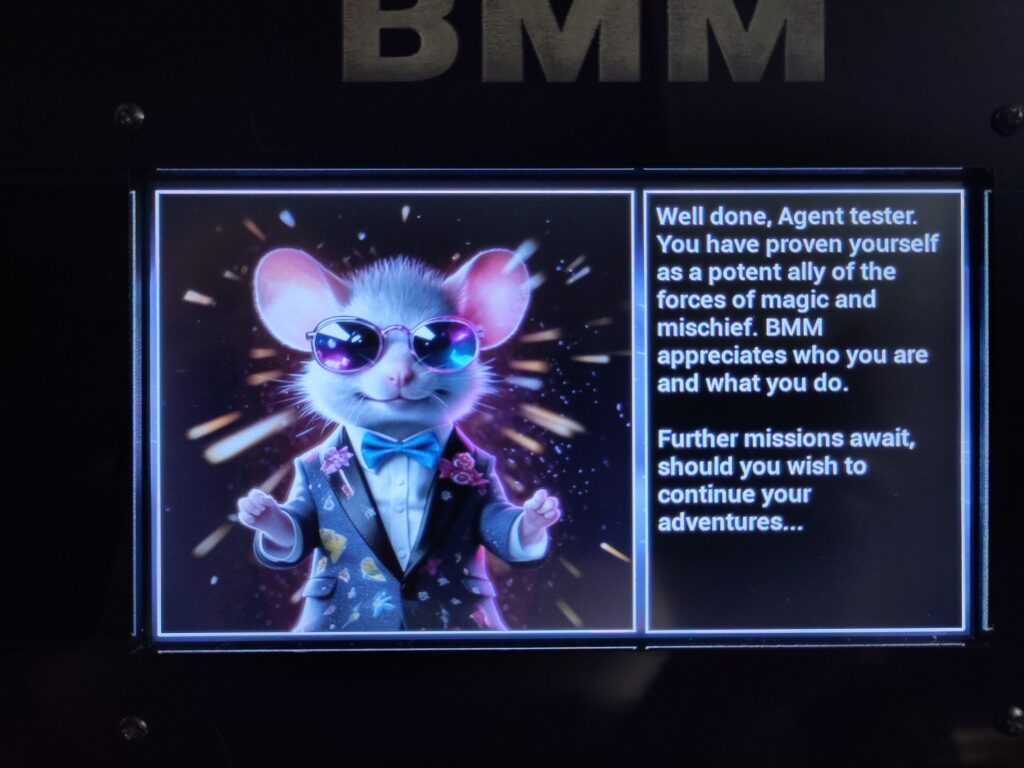
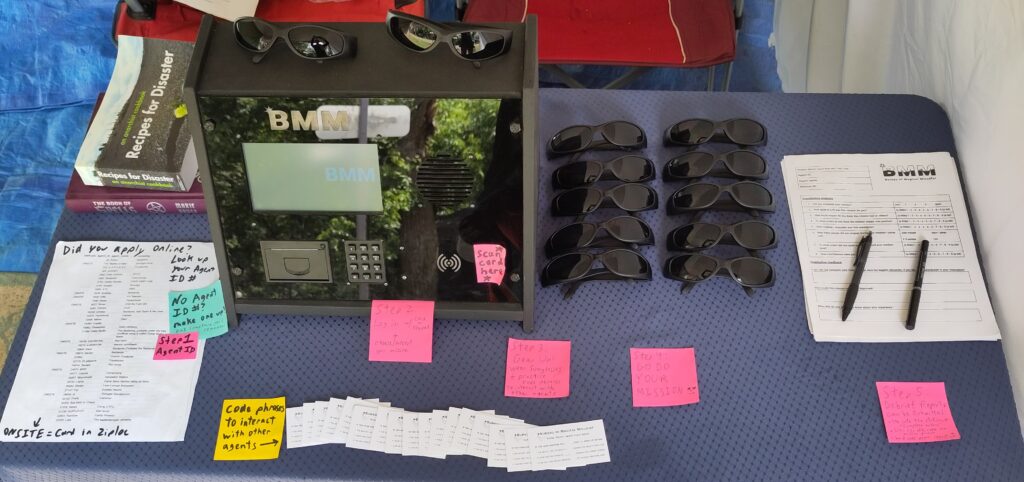
At the event, agents approached the station with their mailed card or, if they were encountering the project for the first time on-site, registered as a walk-up agent directly at the kiosk. Either way, the flow was the same: tap the card or enter an ID on the keypad, and the station presented a choice of two missions tailored to your Enneagram type. Select one, and the thermal printer produced a physical mission ticket – a printed card with the full mission text and title. An attendant handed over BMM-issued dark sunglasses and a “code phrases” card for signaling to other agents in the field. Then you went.
The range of what missions actually asked was deliberately wide. Some were introspective and quiet. Some were social and a little absurd. Many were tied to specific places around the event, like a particular camp’s stage, a dance floor, a crowded art installation, so the missions were woven into the geography and community of Flipside rather than floating free of it. All of them were specific: not “talk to someone” but a concrete invitation with a defined ending.
Three examples from the mission library:
RABBIT HOLE EFFECT (Enneagram 4 – the Individualist)
As soon as possible initiate a conversation with a newbie or a new friend. Drive the conversation with curiosity and questions. Do your best to answer questions about you politely but very briefly and relate their question back to more curiosity about the other person. Allow yourself to be genuinely fascinated or even enamored with that person. Focus on their beauty. See how far down the rabbit hole of learning you can go. Your mission is complete when you thank the other person for sharing themselves with you and your curious questions.
MAKE LIKE A VAMPIRE (Enneagram 7 – the Enthusiast)
For one to three hours one evening, wait at the edge of any experience, camp, or threshold, to be invited in before you enter. Do not explain this to your friends in advance. It is OK if they figure it out, but the goal is not to have friends make this easy. Rely on your charm and wit to get invited into space other people enter without any invitation. Your mission is complete when you feel you have earned your way into three camps. Feel free to be as elaborate or dramatic as you enjoy. For example, make an entourage, act like a star and hang around outside until you are invited in. Have fun.
COUNCIL OF DUNCES (Enneagram 1 – the Reformer)
First, playfully recognize a “problem” in yourself or someone else — not too personal, not too hard. Then seek out a small group of voluntary dunces: a council of the unwise, people who can intentionally give bad advice. Facilitate people taking turns providing absurdist, fun, opposite advice. Allow the person seeking advice to respond to each advisor with “It’s Possible,” “Well Maybe,” and “Try Again Later.” Your mission is accomplished when, after an appropriate amount of time, you choose one absurd bit of advice and try to apply it to a “test” problem to see how it works out.
THE STATION
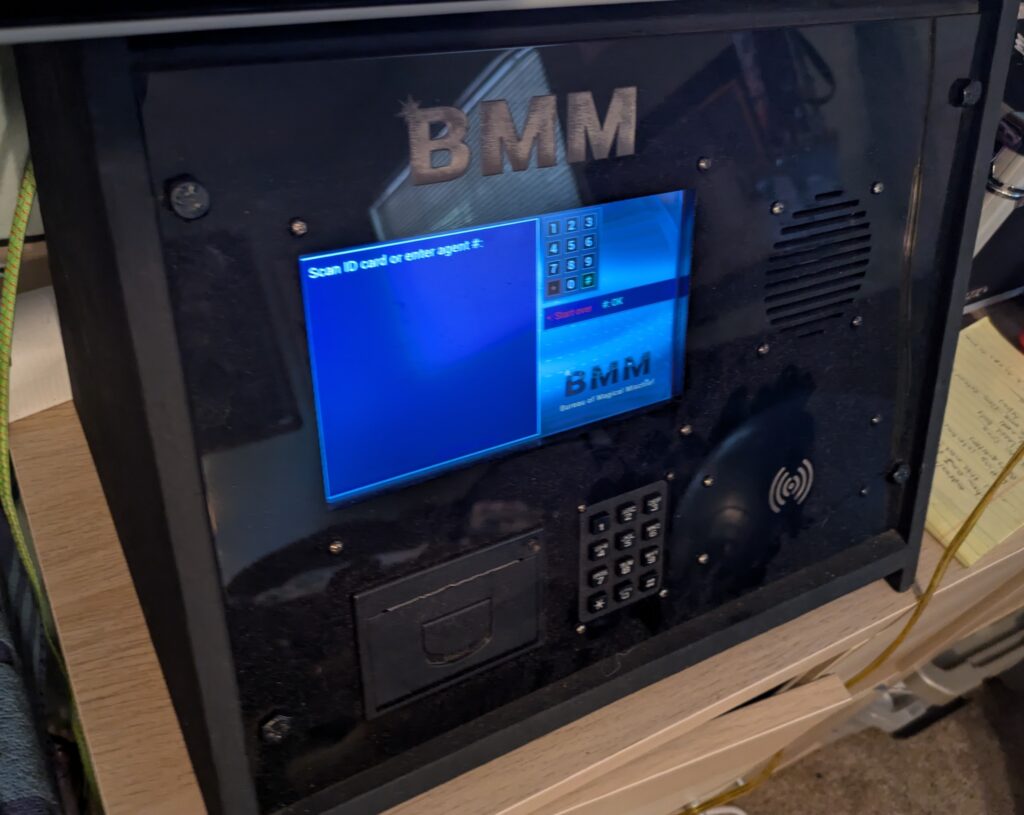
The station was not a tablet in a case or a laptop on a folding table. It was a fully custom-built hardware kiosk, designed, wired, and fabricated from scratch across three shop days in May 2023. The enclosure is half-inch sanded birch plywood, built around the components, painted and finished. The front panel is custom laser-cut and printed plexiglass, designed by Alan Watts of datax.com from component measurements and fabricated specifically for this installation.
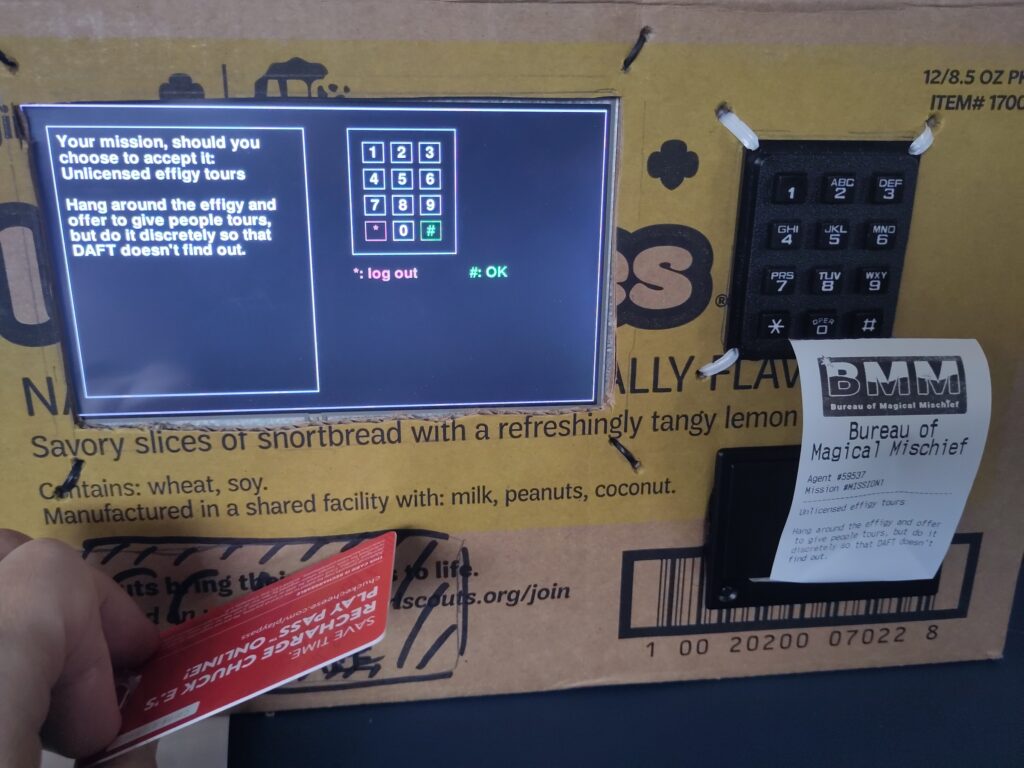
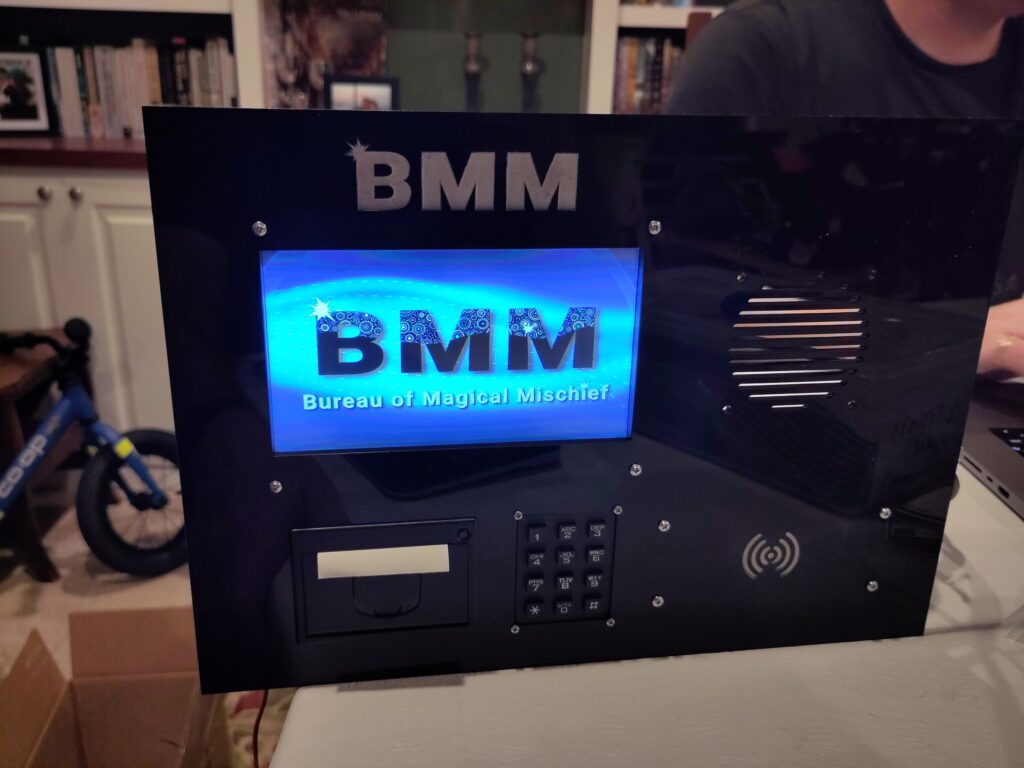
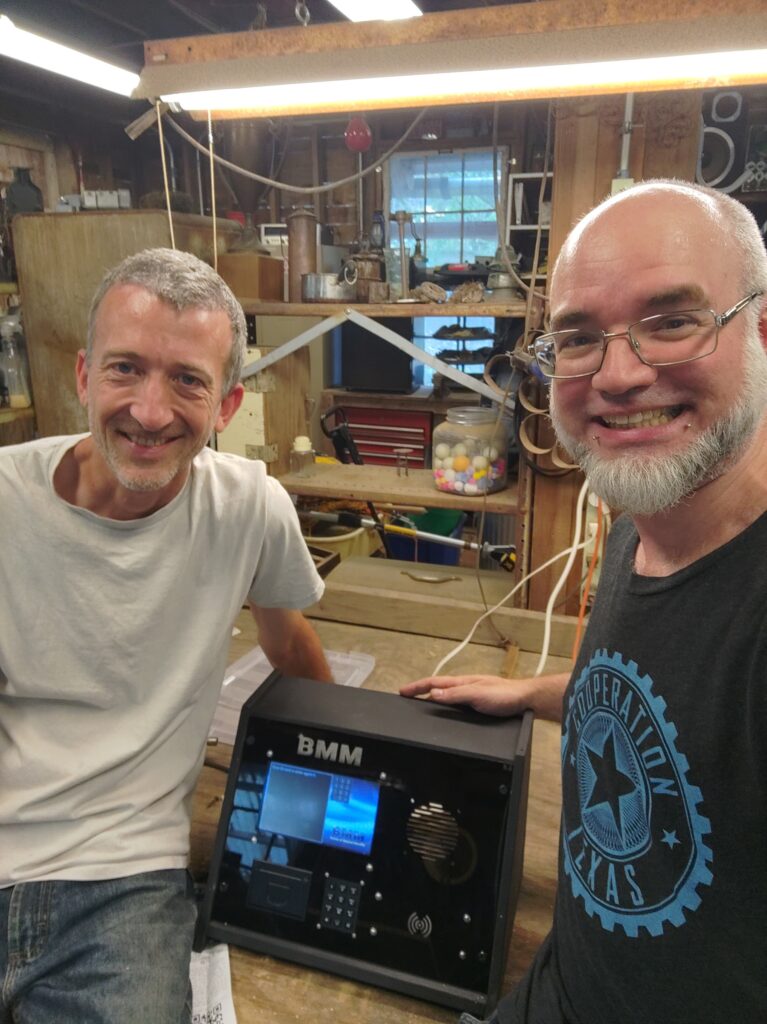
Inside: a Raspberry Pi 4 running a custom Python UI, a 7″ Adafruit touchscreen, a 12-key keypad, an Adafruit PN532 RFID/NFC card reader, a mini thermal printer for printing mission tickets on demand, and an audio amplifier for sound output. Total power draw approximately 5A, managed across the RPi, printer, and peripherals. Every component was chosen and integrated deliberately. There was no off-the-shelf enclosure to drop things into.
The software architecture was a deliberate two-layer design. A Python UI on the Raspberry Pi handled all hardware I/O (screen, keypad, RFID reader, printer), tightly coupled to the physical device. A separate Node.js backend API managed the user and missions database, completely isolated from the hardware layer. That separation was intentional: the backend could be redeployed to a web-only interface or ported to different hardware in a future version without rewriting the mission logic. Agent data moved in and out via a CSV import/export pipeline.
One more detail: packed alongside the station was a full printed binder with all agent records, mission text, and manual administration procedures, a fallback for if the kiosk failed. It didn’t need to be used. But it was there.
“Woah, this is bespoke as fuck”
— a participant, on seeing the station for the first time
That reaction, and the ten to fifteen minutes of investment that followed, confirmed a core design principle: if your presentation is good enough, people will give you the benefit of the doubt and invest significant time to explore and interact with your work.
THE RESULTS
The hardware ran. People engaged. By the measures that mattered most for a debut – get the thing built, get it to the event, have it work, have people interact with it – BMM succeeded. “It felt like a good 1.0 that I could iterate on.”
One hundred forty-eight agents enrolled, 80% of whom logged into the station at the event. Sixty-four of those agents (43% of the total) were walk-ups: people who discovered the project on-site and registered on the spot. Some spent ten to fifteen minutes filling out the on-site application just to gain access. The invitation was compelling enough to earn real investment from people who had never heard of BMM before that afternoon.
Among the twelve agents who completed post-mission debrief surveys, satisfaction was high across every dimension: mission fit averaged 8.1 out of 9, enjoyment 8.1, perceived impact on others 8.2, creativity inspired 7.3. These represent a self-selected group, people who returned to the station to debrief are the experience at its most engaged, but the scores are real.
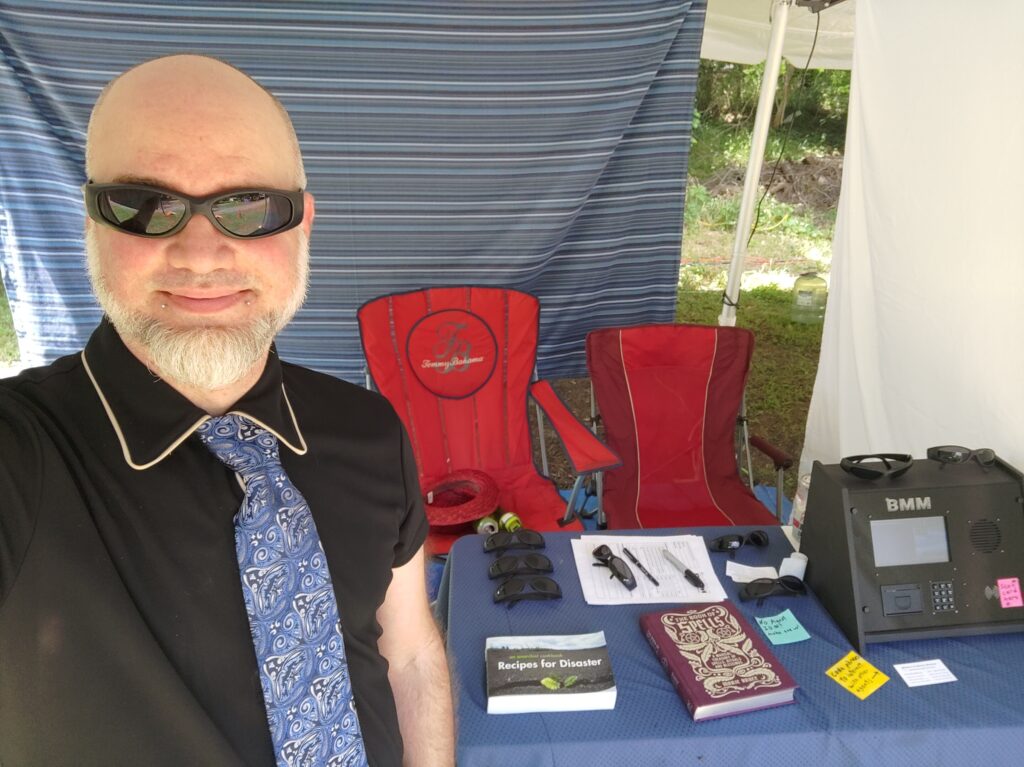
The lessons from the first run were clear. The walk-up interface assumed a system familiarity that first-time users didn’t have: better onboarding was needed. A database primary key bug, only detectable at the scale of a live event, affected mission completion tracking; the lesson is practical and applicable forward: there are failure modes that load testing surfaces and pre-deployment testing misses, and the response is to build that testing in before the next event. The post-it note “patches” visible on the station table in the photos are an honest artifact of a 1.0, charming in retrospect, solvable with preparation.
WHAT’S NEXT
A second version of BMM is in planning. The station itself is solid. The iteration is in the experience architecture around it. Version 2 means more agents working in the field throughout the event, not just stationed at the kiosk: the ambient world-building layer that the first run didn’t have full capacity for. These are volunteers in costume somewhere on the spectrum from bureau to magical. Picture a rainbow unicorn in a suit jacket and dark sunglasses, or a MIB agent with a fox tail, who are simply out at the event, playing their role, occasionally sizing up a stranger as potential recruit material. It also means a designed induction experience: a passageway through which new agents are oriented, built to give people a moment of transition and state change before their first mission. Better onboarding for walk-ups, cleaner first-time flow through the station interface, and pre-event load testing round out the technical improvements. And it means a real post-event community structure: a mailing list, an agent group, a way for the people who went through the experience together to stay in contact after the weekend ends.
What BMM demonstrates, and what it was designed for, is that hardware, software, project management, and creative experience design can all live in the same hands. The station doesn’t feel like a computer science project wearing a costume. The missions don’t feel like they were written by someone who has never soldered a connection. The integration is the point: these things reinforce each other, and together they’re what make something feel genuinely bespoke.
Hardware, software, project management, and the creative drive to build bespoke immersive art experiences – these are all the ways I’d love to collaborate with other artists and builders. If you’re interested in collaborating, drop me a line!
Project website: bmm.quest
CREDITS
Benjamin Bradley – Project lead, hardware build, software architecture, project management:
Doug Harrison – Mission design, application design, Enneagram typing
Alan Watts (datax.com) – Front panel design, housing fabrication